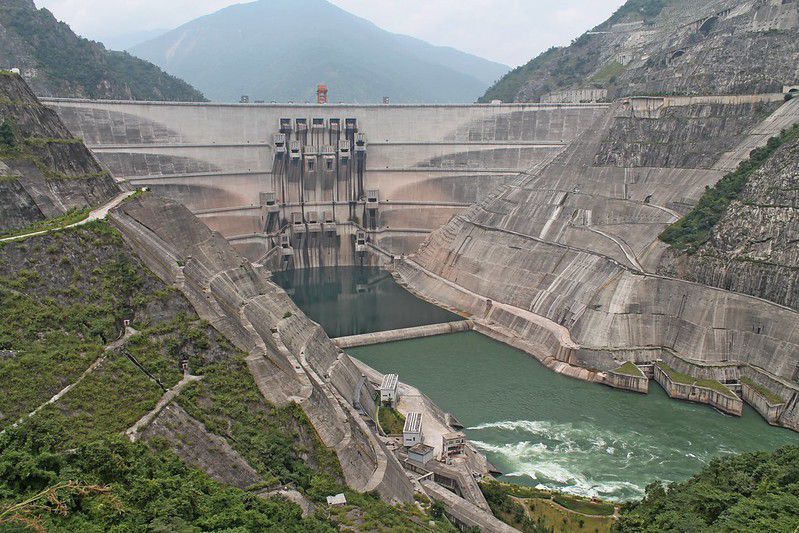
China is building a $167 billion mega-dam on the Yarlung Tsangpo River in Tibet. This is the same river that, upon entering India, is known first as the Siang and then as the Brahmaputra. This region of China is among the most seismically sensitive areas in the world, where earthquakes, landslides, and glacial activities are common. Constructing such a massive structure in such a fragile terrain is not merely an engineering challenge, but a serious issue connected to the lives and future of millions of people.
However, China remains firm on its objective. It does not matter to China whether floods occur in India or droughts set in. Its aim is to push forward its own development and exert strategic pressure on downstream regions. If China suddenly withholds water or releases it without warning, devastating floods completely unexpected could strike Arunachal Pradesh and Assam, the impact of which would inevitably extend to Bangladesh as well. Experts have already warned that India currently lacks adequate early-warning and disaster-management mechanisms to deal with such situations.
Dr. Atop Lego- Retired Chief Engineer (PWD), warns.“The real threat is not just the dam itself, but the absence of transparent data-sharing and early warning systems. An uninformed or sudden release of water from upstream can trigger catastrophic flooding in downstream regions within hours. Without credible sources of real-time data and preventive infrastructure, India is leaving millions of people in the Northeast exposed to a disaster that can be neither predicted nor managed in time.”
But this crisis is not limited to the possibility of a large-scale disaster alone. Its deepest and most lasting impact will be felt in Arunachal Pradesh’s Siang region, where the river is not just water, but life itself. The Adi tribal communities here have long opposed dam projects. For them, this is not merely a question of land or compensation, but of identity, culture, and survival. Riverbank farming, fishing, and traditional festivals held along the banks of the Siang River form the very soul of their emotional and social life.
Yet there is also a bitter truth: even if India chooses not to build dams out of respect for public sentiment, destruction is still inevitable and that destruction will be brought by China. Water will be withheld without information and then released suddenly. In such a situation, neither agriculture, nor homes, nor culture will survive. The safety of the infrastructure in the vicinity of Siang River shall be uncertain due to unpredictable level of flood during sudden release of water from the Dam in China. This is why the Indian government is considering strategic dam projects, so that people in this region are not forced to face unknown disasters in the future.
The greatest concern is the destruction of river ecology. If China’s upstream dam alters the river’s natural flow, fish populations could collapse. This would directly affect small families whose livelihoods depend entirely on fishing. If the river dries up, this will vanish taking with it a simple, affordable, and secure food source for these households.
The irony is that if one opposes India’s dams, one becomes completely helpless in the face of China’s dams. China will store water, release it, and apply pressure according to its own interests. In such circumstances, it becomes essential for India to build strategic projects like the Siang Upper Multipurpose Dam, so that some degree of control over water can be maintained and large populations in Assam and Arunachal can be protected from floods, and during drought conditions, stored water from India’s own dams can be released.
This debate is not about development versus culture. The real question is whether we can afford to leave our rivers, our people, and our future to the decisions of another country. This project is no longer just about electricity; it has become a question of sovereignty, security, and the protection of the soul of Himalayan river civilization.